Hydrogen reaches the sensing film.
A semiconductor film sits on patterned platinum electrodes.

A semiconductor film sits on patterned platinum electrodes.
External electronics measure the change in current during hydrogen exposure.
Record the response or combine sensing points in a monitoring network.
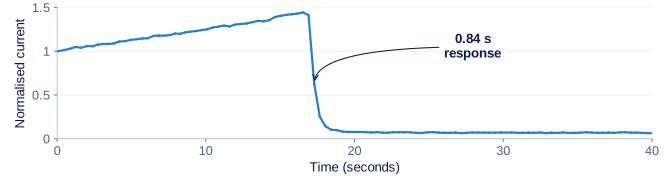
The current changes sharply when hydrogen is introduced, giving a clear signal for external readout.
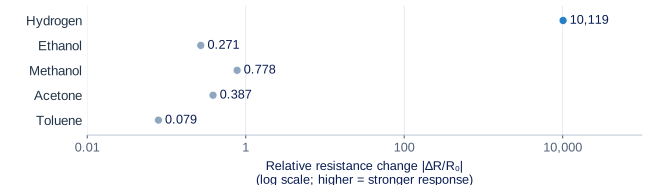
A much stronger response to hydrogen than to the four tested solvent vapours.
Recovery was slow after 1,000 ppm NO₂ exposure. Discuss your gas conditions →
A robust organic hydrogen sensor for distributed monitoring applications
Mandal et al. · Nature Electronics 8, 343–352 (2025).
The study includes hydrogen-generation monitoring and external wireless-readout demonstrations, including a drone-mounted sensor.
Read the paperShare your measurement needs and request the AX-H2-01 datasheet.